

Effective Personalised Business Stickers
A good sticker is noticed in a second, understood straight away and stays in place for as long as needed. For a brand, well-designed personalised business stickers are not just about looking nice. They help identify, signal, promote, package and remind people of your name in the field, in store, on a parcel or during an event.
That is precisely what makes them valuable in professional communication. The medium is simple, quick to produce, easy to distribute and cost-effective as soon as you need volume. However, not all stickers serve the same purpose. The right choice depends on the format, the surface, the expected lifespan and the visual finish you want.
Why stickers remain a highly cost-effective medium
In many businesses, the communication budget has to cover several needs at once. You need to be visible, equip teams, prepare a trade show, personalise packaging or mark out a point of sale. The sticker has an immediate advantage: it fits anywhere without heavy logistics.
On packaging, it turns a plain wrapper into a brand asset. At events, it is used to hand out a visual, identify a campaign or quickly dress up a stand. For shops, it can display practical information, opening hours, an offer or an instruction. For an association, a school or a local authority, it is also a simple way to mark equipment or spread a clear message.
The real strength lies in the cost-to-visibility ratio. As quantities rise, the unit price drops significantly. This makes it a logical solution for organisations that order regularly or need an easy-to-renew medium.
Uses for personalised business stickers
Speaking of personalised business sticker in the singular would be misleading. In practice, it is a very broad family of media. A packaging sticker does not serve the same function as a shop-window decal or a series handed out at a trade show.
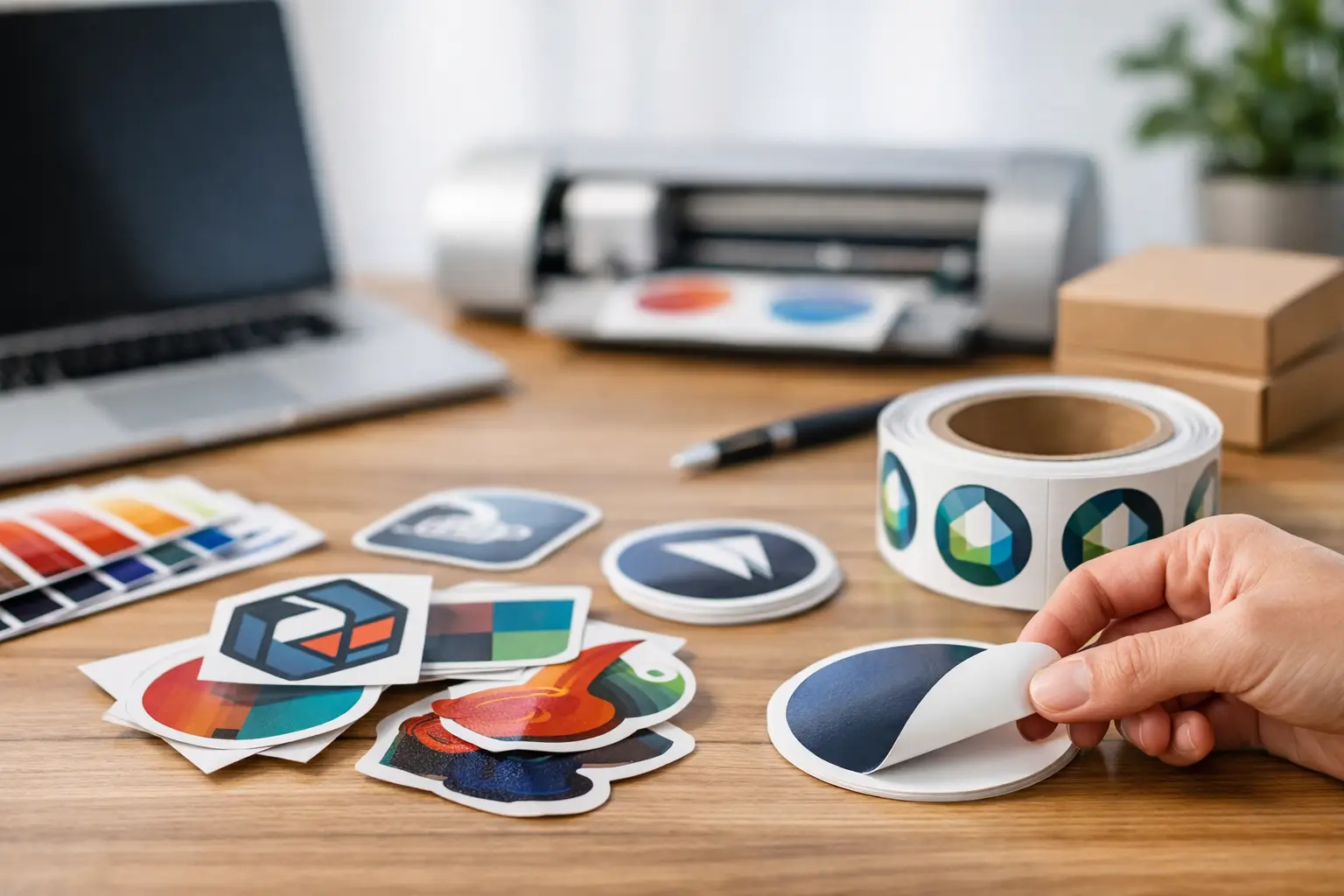
The most common first use is brand identification. Logo, slogan, campaign colour, QR code, event name or product mention: all of this can be printed in a compact format, ready to apply. It is useful for parcels, bags, boxes, pouches or the products themselves.
Next comes the promotional use. A sticker handed out at an event, slipped into an order or given out at the point of sale often continues its life elsewhere: on a laptop, a notebook, a water bottle, an indoor window. Its display time can far exceed that of a flyer.
There is also a more operational use. Some businesses order stickers to organise stock, indicate a zone, recall a procedure or distinguish product references. In this case, visual appearance matters, but legibility and durability matter even more.
Format matters as much as the visual
A good visual that is wrongly sized rarely gives a good result. This is a classic pitfall in professional orders. Sometimes too much information is squeezed onto a small sticker, or conversely a large format is printed with a graphic that is too light.
The round format works well for a logo, a pictogram or a short identity. The square and the rectangle are better suited as soon as text, a web address, a batch number or commercial information needs to be included. Custom die-cutting, meanwhile, gives a more pronounced finish and strengthens the personalised effect, especially for stickers distributed for promotional purposes.
You also need to consider the reading distance. A sticker on a package is viewed up close. A decal on a shop window or a kiosk must remain legible from several metres away. This detail changes the text size, the stroke thickness and the level of detail in the visual.
Small format, large volume
The small format is often the most cost-effective for wide-scale distribution campaigns. It is easy to store, quick to hand out and adapts to many uses. It is a coherent option for parcels, promotional items, sales promotions or simple marking.
Bespoke format for a more premium use
When you are looking for a more distinctive look, a personalised cut takes over. It can follow the shape of a logo, an object or an illustration. The result is more refined, but it requires a clean file and a visual designed for this finish.
Paper or vinyl: the right medium depends on the conditions
The choice of material should not be made out of habit. It depends directly on the end use. Paper stickers work very well for labelling, packaging or indoor application over short or medium terms. They are economical and effective if the technical requirements remain simple.
Vinyl is better suited when greater durability is expected. It holds up better against moisture, friction and repeated handling. For a shop window, an exposed surface, a container that is frequently handled or prolonged use, it is generally the safest choice.
You also need to anticipate the application surface. A smooth carton, a box, a kraft bag, plastic, painted metal or glass do not all react in the same way. A beautiful print cannot make up for poor adhesion. This is why a professional project should always be planned with its actual surface in mind.
Glossy or matt finish: a question of use, not just style
A glossy finish catches the light more, enhances the colours and gives a livelier look. It works well for promotional visuals, colourful logos or high-impact campaigns. On the other hand, it can create reflections depending on the lighting.
A matt finish is often preferable for a more understated, more premium or more legible result on certain texts. It suits brand worlds that want something clean, without a pronounced glossy effect. In a professional context, the choice between matt and glossy should therefore follow the actual use of the sticker, not just a graphic preference.
Preparing your file properly to avoid nasty surprises
Print quality is determined before the machine even starts. A logo taken from a screenshot, text that is too small or a low-resolution image quickly gives a disappointing result. On a sticker, every flaw is immediately visible.
To achieve a clean result, you need a sharp file, consistent colours and a layout suited to the final format. Safety margins are essential, especially if the media is die-cut to shape. An important element placed too close to the edge may be visually cropped or lose its impact.
You also need to be realistic about how much information you include. A sticker is not a brochure. If the message is overloaded, it becomes hard to read and the commercial effect drops. Better to have a short message, a clear logo and a simple visual hierarchy.
Ordering at the right price without compromising the result
Price depends mainly on the format, material, finish, die-cutting and quantity. For this type of product, volume changes the equation considerably. The larger the order, the more attractive the unit cost becomes. For a company that uses this medium regularly, it is often more cost-effective to plan ahead than to place multiple small, urgent orders.
That said, looking for the lowest price is not always the best decision. If the sticker needs to last, withstand handling or properly represent your brand image, you should choose a suitable solution. A basic medium for a demanding use often ends up costing more through reprinting, lost time or a diminished brand image.
This is where controlled production makes the difference. When manufacturing is in-house, lead times are clearer, technical choices are better defined and consistent quality is easier to maintain. For clients who need a fast and transparent process, this is a real operational advantage. At Geekmonkey, this in-house production approach is precisely what allows us to respond quickly, with volume-based pricing designed for professional orders.
When a sticker is the right choice
The sticker is not always the main medium, but it is often the most agile. If you are launching a range of products without redoing all your packaging, it makes sense. If you are preparing a trade show and need an easy-to-distribute medium, it makes sense too. If you need to identify equipment quickly, mark out an operation or add brand marking without tying up a large budget, it remains one of the most effective options.
The key is to treat it as a genuine communication medium, not a simple accessory. A good format, a clear visual, a consistent material and an order planned in volume will make a real difference to the result.
Before you confirm your next series, ask yourself one simple question: where will this sticker be seen, handled and kept? The right answer always starts there.








Leave a Reply