


Personalised company notebook: the right choice
At a trade show, in a meeting or in a welcome pack, the personalised company notebook is one of the rare items that really stays on the desk. It does more than display a logo. It supports note-taking, a client meeting, internal training or an event day. For a brand, it is a simple, useful and durable item, as long as you choose the right format, branding and quantity.
Why the personalised company notebook still works
Many promotional items are seen once and then forgotten. The notebook has a clear purpose. It is useful straight away. That is precisely what makes it an effective promotional item for companies, associations, schools and event organisers.
Its value is twofold. On one hand, it carries your organisation's image through visible branding. On the other, it genuinely serves the person who receives it. This combination of usefulness and visibility remains one of the most cost-effective approaches in promotional merchandise.
Another concrete advantage: the notebook adapts to many contexts. It can be handed out at a trade fair, included in an HR welcome pack, given to clients or used internally by teams. The same product can therefore meet different objectives without complicating your purchasing.
Which personalised company notebook to choose based on use
The right product depends mainly on the distribution context. Wanting one notebook for every purpose is not always the best option.
For trade shows and events
At an event, a compact format is often the most relevant. A notebook that slips easily into a bag is more likely to be kept. The aim here is not necessarily to offer a premium item, but a practical support that is quick to distribute and consistent with your bulk budget.
The design must be readable at a glance. A well-placed logo, a cover colour that matches your brand guidelines and clean branding generally have more impact than an overly busy design.
For welcome packs and corporate gifts
If the notebook is intended for employee onboarding or as a client gift, you can move up a level. A more refined cover, a higher-quality finish or more discreet branding give a more professional impression.
In this case, the notebook is no longer just a promotional item. It contributes to your company's overall image. It should therefore be consistent with the other elements of the pack, such as a pen, a mug, a tote bag or a personalised textile.
For internal use
For teams, the logic is somewhat different. What is needed above all is a practical product, available quickly and easy to reorder in quantity. The notebook then becomes a personalised working tool, useful every day, while reinforcing the company's visual identity.
Here, avoid overpaying for finishes that add little value. It is better to prioritise good value for money, especially if reorders are regular.
The criteria to consider before ordering
A notebook may seem simple, but a few technical choices clearly change both the result and the use.
The format
The small format is practical for events and travel. The intermediate format is often the most versatile for companies. A larger format is better suited to note-taking in meetings or training sessions. The right choice depends on the expected mobility and the space available for your personalisation.
The cover
The cover makes the first impression. A soft finish is lightweight and economical. A more rigid cover gives a more structured look. If you are aiming for a premium image, this point matters more than you might think.
The type of personalisation
Depending on the notebook chosen, several branding techniques can be considered. The key point is not to choose the most spectacular technique, but the one that gives the best result on the selected support. Some covers show a simple, high-contrast branding particularly well. Others require a more precise approach to keep the logo legible.
The number of copies
The volume has a direct impact on the unit price. For a campaign, a trade show or a multi-site distribution, tiered pricing often tips the balance in favour of a personalised notebook. Conversely, for a small premium series, what matters most is the final finish and how well it fits your goal.
Personalisation: what to put on a notebook
A corporate personalised notebook does not need to be overloaded to be effective. On the contrary, overly dense markings often lose legibility.
The most common choice is the logo alone, centred or placed discreetly. It is an effective option if your visual identity is already strong. You can also add a short slogan, an event name or a service mention, as long as a clear visual hierarchy is maintained.
For one-off campaigns, a dated or co-branded notebook can be relevant. However, you need to weigh the trade-off: the more specific the message, the shorter the useful life may be. A generic notebook in your company colours often remains more durable than an item too closely tied to a single operation.
The notebook as a cost-effective communication tool
In many cases, the notebook offers a good balance between cost, visibility and usefulness. It is not the most eye-catching item, but it is one of the most consistent in real-world use.
A tote bag circulates more widely, a mug stays highly visible, and a pen is easily handed out. The notebook occupies an interesting place between a practical item and an image-building medium. It accompanies the user in a professional setting, often in front of other people. This discreet visibility is valuable.
There are still limits. If your target audience takes very few notes, or if your event is aimed mainly at the general public, another promotional item will sometimes be more suitable. The choice therefore depends on the end audience, not just on your product preference.
Ordering a personalised corporate notebook without losing time
For a professional buyer, the real question is not only the product. It is also how simple the ordering process is. If personalisation takes too long, if the options are unclear or if lead times remain vague, an otherwise relevant item quickly becomes a hassle.
This is where a simple design tool and a well-controlled production process make the difference. Being able to preview your branding, quickly select quantities and get a clear pricing framework helps you decide faster. For recurring needs, this smoothness matters just as much as the product itself.
In-house manufacturing also offers a concrete advantage in terms of quality control and responsiveness. For companies that need to equip a trade show, prepare a communication operation or put together packs in series, this point is far from secondary. At Geekmonkey, this approach meets precisely the expectations of organisations that want to order quickly, with a clean finish and prices suited to volume.
When a notebook is a better choice than another promotional item
The notebook is not automatically the best option. However, it becomes highly relevant in three cases: when you are targeting professional use, when you are looking for an item with a good perceived value without overspending, and when you want visible personalisation without relying on a product that feels too gimmicky.
Compared with a pen, it offers more space for branding. Compared with a textile, it often requires a more accessible entry budget. Compared with a purely promotional object, it has a practical use as soon as it is received. This combination explains its lasting place in communication purchasing.
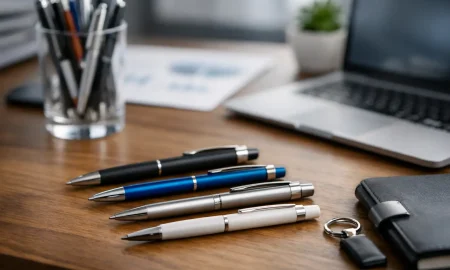
To go further, it is often wise to think of it as a duo with another item. A notebook paired with a personalised pen works very well at events and training sessions. In an employee pack, it fits easily alongside a mug or a tote bag. The whole set stays coherent, useful and easy to distribute.
Preparing your file properly for a clean finish
Even the right notebook will produce an average result if the starting artwork is poorly prepared. A blurred logo, insufficient contrast or poorly planned placement is immediately visible on the cover.
You should therefore start from a clean file, with a legible visual identity and markings suited to the available area. In most cases, a simple design works better than an overloaded cover. Sharpness, balance and consistency with your image should remain the priority.
If you are torn between several versions, ask yourself a simple question: which one will still be relevant in six months? This is often the best filter for avoiding personalisation that dates quickly or is tied to a single operation.
A well-chosen personalised notebook does not try to do too much. It should be useful, easy to distribute, pleasant to keep and consistent with your budget. When these four points are aligned, you get an effective communication tool that is simple to order and genuinely used.








Leave a Reply