
Personalised advertising pen – how to choose it well
A trade show often starts with a very concrete detail: someone leaves with your contact details in their pocket, on a notepad, or on a desk for weeks. That is where the personalised promotional pen has a real advantage. It costs little, circulates easily, is useful straight away and gives your brand a regular presence without any effort.
For a company, school, association or local authority, this item remains one of the simplest to roll out. It suits mass distribution, welcome packs, business events, reception desks and local campaigns. Its appeal lies not in a passing trend but in daily use. A good pen does not just display a logo; it is kept, lent, used and looked at again.
Why the personalised promotional pen still works
The main asset of a pen is its function. Unlike some purely visual promotional items, it meets an immediate need. People take it because they have a use for it. This usefulness changes everything for brand recall. Your design is not just seen once at a stand; it comes back every time someone takes notes.
Another decisive point is the cost-to-visibility ratio. For volume operations, few items offer such wide reach on a controlled budget. This is particularly relevant for trade shows, open days, field campaigns, training centres, administrations or sales networks that need a simple product to hand out in quantity.
Logistics matter too. A pen takes up little space, is easy to transport, fits into a parcel or welcome pack and does not complicate event organisation. When you need to order quickly, store without difficulty and distribute across several sites, that is a genuine advantage.
Which type of personalised promotional pen to choose
Not all promotional pens serve the same purpose. The right choice depends on the distribution context, the budget and the image you want to convey.
For wide distribution
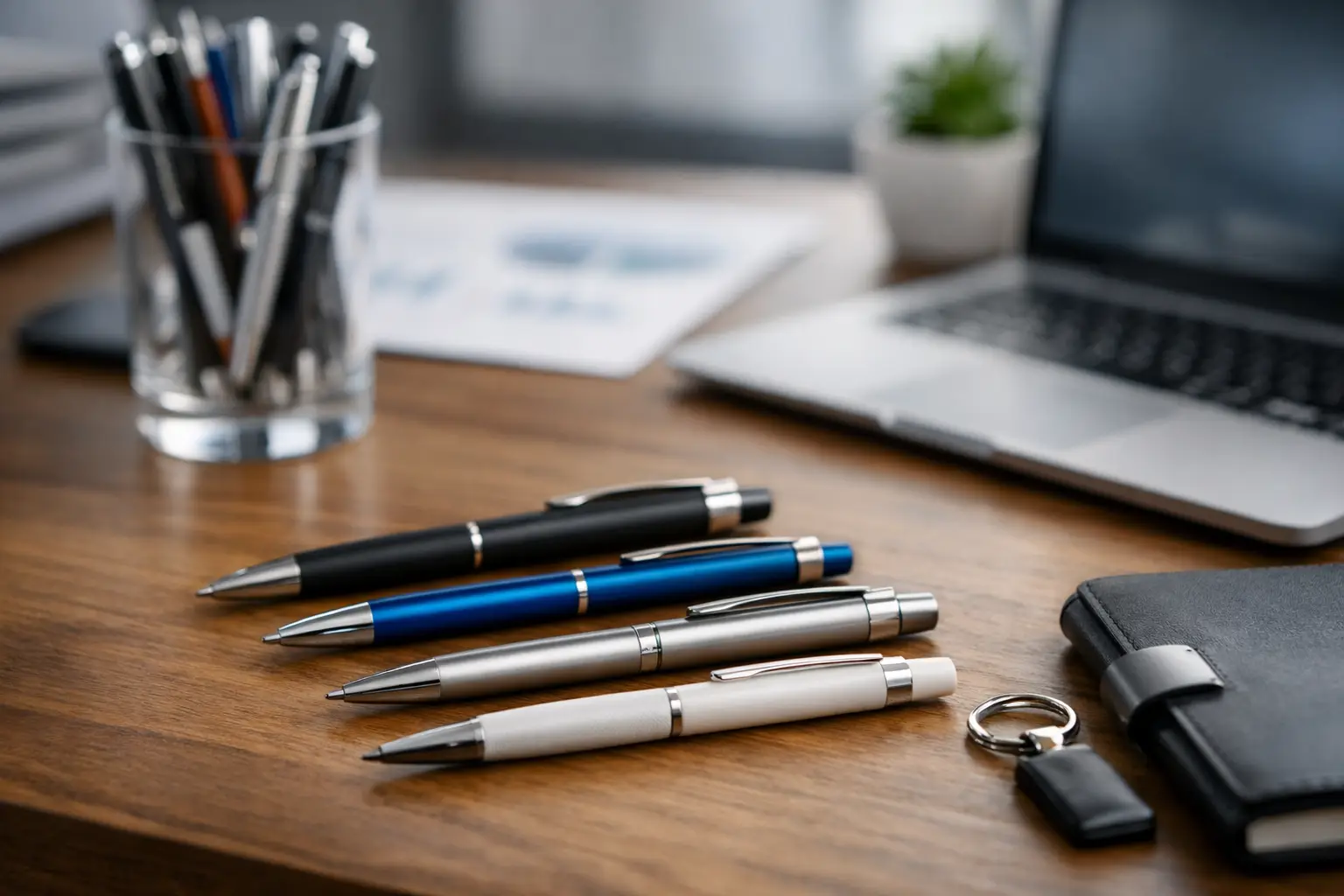
If the aim is to reach many people on a tight budget, the classic plastic pen remains the logical choice. It allows you to order in quantity at a low unit cost. For a trade show, a local prospecting campaign or a reception desk, it does the job. However, pay attention to writing quality and print durability. A low price only makes sense if the product remains pleasant to use.
For a more polished look
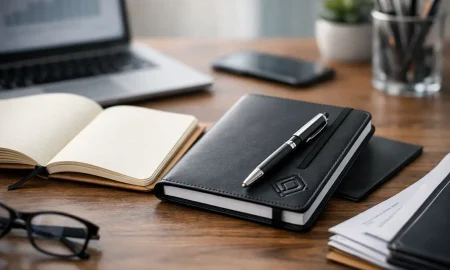
Metal pens, or models with more premium finishes, suit sales meetings, client gifts and corporate kits better. The result conveys more seriousness and durability. It is not necessarily the best choice for mass distribution, but it can be relevant if you are targeting fewer people with a more qualitative intent.
For more visible CSR commitments
Pens made from bamboo, recycled cardboard or recycled plastic respond to an increasingly common demand. They do not replace every use, as the visual result, feel and sometimes cost all change, but they can reinforce the consistency of responsible communication. Again, it all depends on context. For a local authority, school or company committed to these issues, the item matters just as much as the printed message.
Pen personalisation – what makes the difference
An effective personalised promotional pen is not a catalogue of compressed logos. On a small print area, you need to get to the essentials. A brand name, a legible logo and sometimes a short URL or number are often enough. Trying to fit everything in weakens the result.
Legibility must remain the priority. A design that is too fine, too detailed or poorly contrasted can lose impact once printed. The colour of the pen also matters. A light logo on a light pen, or a dark logo on a dark pen, greatly reduces visibility. It is a simple point, yet it is still often underestimated.
The mechanism and shape of the pen also count. A well-placed print area, visible when the pen is set down or held, improves brand presence. Conversely, marking that is too discreet or badly oriented can go unnoticed. The item must remain functional, but the personalisation should be designed to be seen without getting in the way of use.
Which printing techniques give a good result
The choice of printing technique depends on the material, the design and the expected result. On promotional pens, the aim is generally a clean, durable and legible mark.
Pad printing is often used for its precision on small surfaces and rounded shapes. It suits simple logos and designs in one or more colours, depending on the model. It is a common solution for large runs.
Laser engraving, where compatible with the material, gives a more understated and more premium result. It is especially appreciated on metal pens. Its advantage is clear: it offers excellent durability and a more elegant finish. On the other hand, it produces a tone-on-tone effect, so it is less eye-catching than coloured printing.
Some configurations also allow other markings depending on the product. The right choice always depends on the actual item, the colour of the pen, the level of detail in the logo and the intended use. For a professional purchase, it is better to start from the expected result rather than choose a technique in the abstract.
Where the personalised promotional pen is most profitable
This item is particularly effective when it fits a concrete use. At events, it remains a classic at trade shows, conferences, recruitment fairs and seminars. It slips easily into a tote bag, accompanies a notepad and gets used straight away during the day.
In offices, agencies, shops or reception areas, it plays a quiet but continuous role. A pen left out for use is handled by visitors, customers and staff alike. The brand stays visible without any extra effort.
For schools, training centres and local authorities, it is also a practical item for the start of term, meetings, information days or internal distributions. Its value is then twofold: immediate usefulness and simple management of volumes.
Finally, for SMEs and sales networks, it works well in parcels, quote handovers, welcome packs or local campaigns. The object does not carry the entire communication on its own, but it extends contact effectively.
Ordering your personalised pens without wasting time
A successful purchase starts with three simple questions: how many units, for what purpose, and at what level of brand image. These answers help avoid common mistakes, such as ordering a model that is too basic for an important client meeting, or too premium for mass distribution.
Volume directly influences the unit price. For many organisations, tiered pricing makes the pen a very competitive promotional item as soon as quantities increase. This makes it possible to plan annual needs rather than placing several small, less advantageous orders.
Lead times also need to be factored in. Between proof approval, production and delivery, it is best not to wait until the eve of an event. Organisations working to tight deadlines are well advised to choose a clear process, with simple personalisation and controlled manufacturing. This is precisely what professional buyers are looking for: fewer back-and-forths and greater visibility over the result and the schedule.
When production is handled in-house, monitoring is generally more reliable in terms of quantities, marking quality and responsiveness. For a promotional item that is ordered as often as the pen, this consistency matters as much as the price.
The right pen is not necessarily the cheapest
Choosing solely on unit price is rarely the best approach. A pen distributed in large numbers that writes poorly, breaks quickly or has hard-to-read marking loses much of its value. Conversely, a slightly better-finished model can stay in circulation for longer and generate greater real visibility.
You need to think in terms of the advertising cost of use, not just the purchase cost. If the product stays on a desk for several months, its return is far greater than that of an item that is quickly forgotten. This is why the pen remains a highly sought-after promotional item, including in modern, budget-driven communication strategies.
At Geekmonkey, this logic naturally fits into a simple approach: online personalisation, in-house production, tiered pricing and delivery across Europe. For professionals, this makes it quicker to move from idea to order, without complicating a purchase that should remain practical.
A good personalised promotional pen does not try to impress at any cost. Above all, it should be pleasant to hold, consistent with your brand image and well enough designed to keep circulating after the event, when many other items have already disappeared.




Leave a Reply