


Promotional items for trade shows
At a trade show, everything happens quickly. A few seconds to attract a visitor, a few minutes to exchange, then dozens of exhibitors to tell apart once the day is over. This is where trade show promotional items gain real commercial value. When well chosen, they do more than simply please. They extend the contact, keep your brand visible after the event and improve the concrete return on your stand presence.
The problem is that many promotional items end up in a bag, then in a drawer, then in the bin. The right promotional item is therefore not the one that costs the least per unit. It is the one that matches your target, your budget, your visitor volume and the way you want to be remembered.
How to choose trade show promotional items
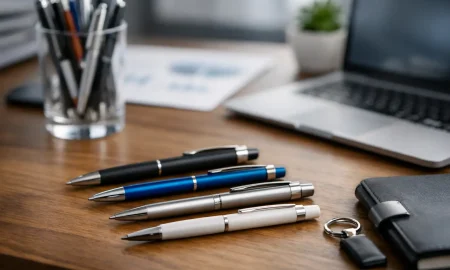
The first criterion is actual use. A useful item stays, circulates and reminds people of your name without effort. A pen, a tote bag, a water bottle, a notebook or a badge each have a different logic. Pens work well for large volumes and wide distribution. Tote bags are more visible in the aisles and are used immediately. Notebooks better enhance a B2B or institutional brand. A water bottle gives a more premium and durable image, but its unit cost calls for more targeted distribution.
The second criterion is consistency with your stand. If you hand out a low-quality item while selling a technical, high-end or bespoke service, the impression left may be counterproductive. Conversely, a simple product that is well printed, with a legible visual and clean personalisation, can perfectly support a serious, professional image.
The third criterion is logistics. At a show, you need to think about volume, transport, storage and speed of distribution. A mug is interesting for certain targeted operations, but it is more fragile and bulkier than a sticker, a magnet or a tote bag. An item that is too bulky often complicates stand preparation. A support that is too small or too discreet, on the other hand, may go unnoticed.
Formats that really work on a stand
Some products remain safe choices because they meet simple needs. Personalised pens keep an excellent visibility-to-price ratio, especially for events with heavy footfall. Personalised tote bags are among the best trade show promotional items, as they are useful straight away and turn visitors into visual ambassadors throughout the day.
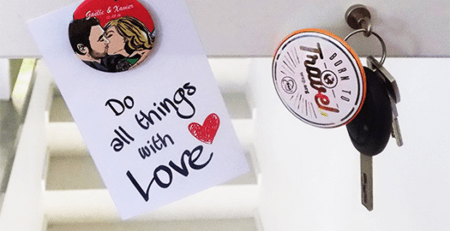
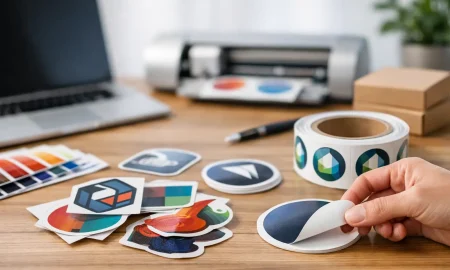
Badges, for their part, are not just identification accessories. They can also be used for animation, team recognition or visitor segmentation during an event. Stickers and magnets work well when the target audience is receptive to light supports that are easy to carry and inexpensive to produce in quantity.
For a more qualitative approach, notebooks, water bottles and personalised textiles are often better suited. A T-shirt or polo worn by the team reinforces the visual unity of the stand. A sweatshirt can be relevant for longer events or shows held in cold weather. As for the notebook, it provides a useful support during talks and often stays on a desk after the show.
Everything therefore depends on the level of qualification you aim for. If your goal is mass distribution, you need simple items that are quick to hand out and financially optimised. If you are targeting high-potential prospects, it is better to reduce volume and increase perceived value.
Price, quantity, impact: finding the right balance
The promotional item budget is rarely considered in isolation. It should be compared with the overall cost of the show, which generally includes stand rental, signage, travel, time spent and sometimes accommodation. In this context, saving a few cents on a useless item does not always make sense if the result is forgotten as soon as visitors leave the hall.
Volume discounts also change the equation. For products such as pens, badges, stickers or tote bags, the price gap between a small run and a larger order can be significant. For organisations that exhibit regularly, it is often more cost-effective to plan ahead and order volumes suited to several events rather than rushing small production runs at the last minute.
You also need to decide between open distribution and selective handout. Open distribution attracts traffic more easily, but it also encourages items to be taken without any exchange. Handing items out after a conversation, a demonstration or a visitor badge scan often produces better commercial results. The right choice depends on your sector, the expected footfall and the maturity of your sales cycle.
Personalisation: what makes the difference in the final result
At a show, the item matters, but the decoration matters just as much. An overly busy design, a logo that is too small or a colour poorly suited to the medium greatly reduces impact. Legibility should come first. Brand name, logo, a short message and useful contact details are often enough. Trying to fit everything onto a small item is the classic mistake.
The choice of printing technique also affects the result. Depending on the medium, a textile, a mug, a badge or a sticker is not worked in the same way. The quality of the finish depends on the file format, the colours, the decoration area and the compatibility between the design and the product. This is why clear guidance and a simple design tool save time when placing an order.
You must also consider how the item will actually be used. A tote bag carried around a show must remain legible from a distance. A pen will be looked at up close. A badge can carry a shorter message. A water bottle can showcase a more understated graphic identity. The right design is not necessarily the most creative one. It is the one that is recognised immediately.
Combining promotional items with stand materials
Promotional items should not work alone. Their effectiveness increases when they fit into a consistent set of communication materials. If your stand uses the same colours, the same key messages and the same visual universe across roll-up banners, textiles and distributed items, recall is stronger.
This consistency is particularly useful for SMEs, schools, associations or local authorities that need to maximise impact on controlled budgets. A well-identified stand, a team dressed uniformly and a useful promotional item create a far stronger impression of seriousness than a jumble of mismatched objects.
It is also a matter of speed for the visitor. At a show, nobody takes the time to decode a vague message. If the item received immediately recalls what they saw on the stand, your communication gains clarity. And clarity helps you stay top of mind once the event is over.
The most common mistakes
The first mistake is choosing a product based only on its unit price. A cheap item that is poorly targeted ends up costing more if it creates no useful memory. The second is overestimating quantities. Too much stock, especially for dated products or items tied to a specific campaign, ties up budget for little value.
Another common issue is lead time. Many event orders arrive late, even though a trade show often requires several items to be coordinated. Planning ahead gives you more choice, better control over branding, and avoids rushed decisions. For organisations that run one event after another, centralising the production of promotional items, textiles and visual materials is often simpler and more reliable.
Finally, do not confuse visibility with effectiveness. Handing out a lot of items does not necessarily mean success. A well-thought-out item, given at the right moment to the right person, often has more value than mass distribution without qualified interaction.
What works best depending on your objective
If your priority is to attract visitors to your stand, focus on visible, easy-to-take formats such as the tote bag or the sticker. If you want to support a more structured sales pitch, the notebook, the pen or the mug can better accompany the relationship. If the goal is to improve brand image, textiles, water bottles or more premium-looking items take over.
For most exhibitors, the best approach is a mix. A first tier of items to create contact, then a higher-quality item for engaged prospects. This logic avoids overinvesting while maintaining a good level of impact. It is also the most realistic way to match your budget to the actual footfall of the show.
At Geekmonkey, this approach is particularly relevant for organisations that want to order quickly, personalise simply and bring several items together in a single preparation. When production is controlled in-house and designed for both large volumes and small runs, the choice becomes more practical.
A trade show leaves little room for approximation. Good promotional items do not replace a strong pitch or a strong stand, but they extend both. If you choose them based on use, volume, finish and your commercial objective, they become a genuine conversion tool, not just an accessory to hand out.








Leave a Reply