
How much does a personalised badge cost?
A personalised badge can cost a few tens of cents, or exceed €2 each. If you are wondering how much a personalised badge costs, the real answer is straightforward: it depends on the format, the quantity, the type of badge and the level of personalisation required. For a trade show, a school, an association or a marketing campaign, the unit price only makes sense when it is considered alongside the volume, the intended use and the lead time.
The right approach, then, is not to ask for an isolated price, but to look at what actually makes up the real cost. This is what helps avoid the gap between an attractive quote at the outset and an order that ends up less advantageous.
How much does a personalised badge cost depending on the product type
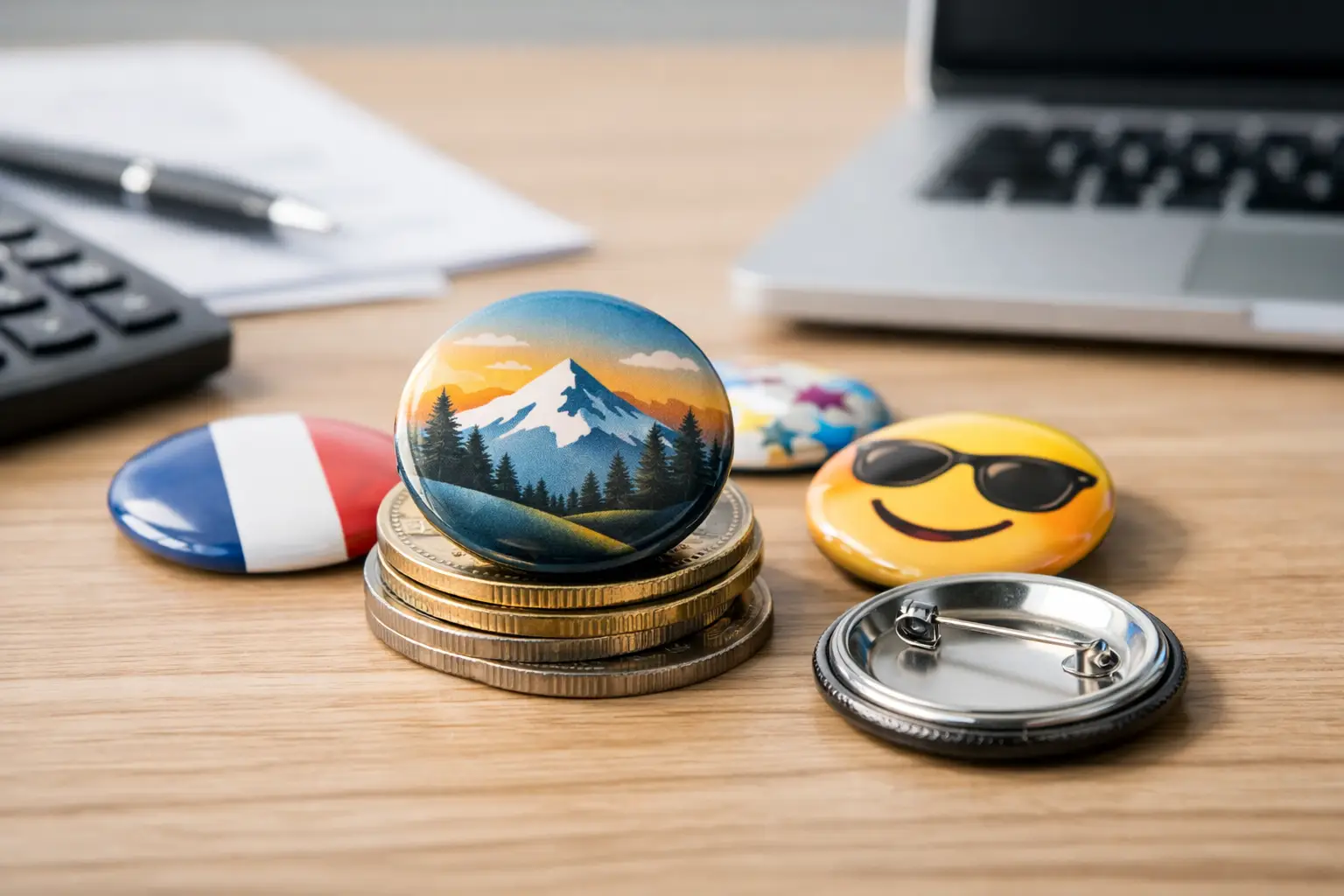
Not all badges fall into the same category. A classic round badge with a pin fastener, intended for distribution at events or for sale as merchandise, is generally the most economical option. It is often the most cost-effective choice as soon as you are working in volume.
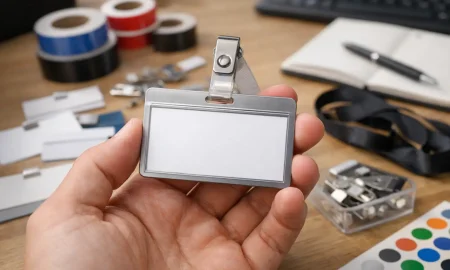
Conversely, a name badge with a magnetic fastening, a rigid model for professional use or a badge designed for long-lasting identification will cost more. Material, fastening system and production time quickly add up in the calculation.
As a rough guide, a standard promotional badge produced in a series can fall below €1 per unit for large quantities. For very small runs, the unit price rises more quickly, as preparation, artwork checking and set-up costs weigh more heavily. A name badge or premium badge can easily exceed €1.50 to €3 each, sometimes more depending on the configuration.
The 5 factors that make the price vary
The quantity ordered
This is the most visible factor. The more you order, the lower the unit price. This is not a commercial detail but a production logic. Preparing the file, setting up the press and launching the job are almost the same for 25 badges as for 500. On a small quantity, these fixed costs are spread across few units. On a large run, they are absorbed.
This is why an order of 300 badges can be far more attractive per unit than an order of 50, even if the overall budget is higher.
The format
A small round badge generally costs less than a large format. The larger the diameter or surface area, the more material consumption and production time increase. For simple promotional use, a compact format is often the best balance between visibility and price.
If your aim is to make a first name readable from a distance or to display a more detailed message, you must accept that a larger format will push the price up.
The type of fastening
The pin remains the most economical and most widespread option. It works well for events, communication campaigns and resale. The magnet, on the other hand, offers more comfort on certain fabrics and a more professional image in welcome or sales contexts. However, it costs more.
The choice should therefore not be based on price alone. If your teams wear the badge all day on delicate clothing, a suitable fastening can prevent very real irritations.
The artwork and personalisation
An identical design across the whole series costs less to produce than individual name personalisation. As soon as a first name, job title or number needs to change from one badge to the next, management becomes more technical. This remains entirely feasible, but the production cost is no longer the same.
For mass distribution, a single design is often the most cost-effective. For internal use, customer reception or a corporate event, individual personalisation may justify a higher budget.
Lead time
A standard lead time generally secures the best price. If you need urgent production, the cost may increase depending on workshop load and the shipping method chosen. This is an often underestimated point, as it can weigh heavily at the last minute.
Planning a few days ahead is sometimes enough to make a real difference to the final budget.
Personalised badge prices: realistic ranges
Talking about prices without a concrete range does not help in making a decision. On the market, a standard personalised badge with identical artwork often falls within these price bands: in small runs, it can be around €1 to €2 each; in intermediate quantities, it frequently drops below €1; in larger volumes, the unit cost becomes significantly more competitive.
For a name badge, rigid or with magnetic fastening, the range rises. It more often lands between €1.50 and €3 each, or even higher depending on finishes and personalisation constraints.
These benchmarks are useful, but they do not replace a precise configuration. A small promotional badge for an association campaign does not have the same cost as a set of identification badges for a sales team.
How to pay the right price without compromising on use
The lowest price is not always the most cost-effective. If the badge is to be worn for two hours at a stand, a simple solution is often sufficient. If the product must stay clean, legible and comfortable for several days or be reused, it is better to look at print quality, durability and the fastening system.
You should also consider the context. For a festival, a campaign, an in-store action or a welcome pack, the badge mainly serves a visibility purpose. For a shop, a local authority, a school or event reception, it also plays an identification role. The right product is therefore not always the cheapest, but the one that delivers on its promise without unnecessary extra cost.
When the quote seems high, what should you check?
A price may seem high simply because it includes more. Check whether it covers in-house production, file checking, printing, assembly, packaging and delivery. Also check whether the artwork is unique or variable, whether the badge is standard or a name badge, and whether the deadline you need is tight.
Another important point is quantity discounts. A quote that looks unremarkable for 100 pieces can become much more attractive at 250 or 500. For professionals and organisers who order regularly, it is often wiser to group requirements together rather than placing several small runs.
How much does a personalised badge cost for an event?
For an event, the budget depends mainly on the role of the badge. If you need a promotional item to hand out, the classic pin badge remains the simplest and most economical option. If you are equipping exhibitors, volunteers or reception staff, name badges offer better legibility and a more structured look.
In practice, many event orders find their balance at a medium to high volume, with a standardised or semi-personalised design. This is often where the cost-to-impact ratio is most attractive. A well-printed, visible badge delivered on time is worth more than a low-priced product that arrives too late or does not match the real use.
What a good supplier should let you do quickly
To buy efficiently, you should be able to configure your badge without wasting time on unnecessary back-and-forth. Choosing the format, sending the artwork, approving the proof and accessing a volume-based price should all be simple. This is especially true for SMEs, schools, associations and event teams that do not have a day to spare for a badge order.
In-house production also brings a concrete advantage: more control over lead times, more consistency in quality and fewer intermediaries. For orders in Belgium and across Europe, this is a real point of stability. It is, moreover, one of the strengths that organisations looking to order quickly, cleanly and without hassle value at Geekmonkey.
Before comparing prices, ask yourself a very practical question: should this badge simply exist, or does it really need to do a job? Once you answer that, the right budget becomes much clearer.
Share this post
Author



Leave a Reply