


Choosing event media
A stand that attracts attention without explaining your offer, a textile that is hard to read from three metres away, a roll-up banner that is fine but arrives too late: at events, the right material is not judged on visuals alone. Event materials are there to capture attention, guide visitors, identify your team and extend brand recall. If they are poorly chosen, you spend money to be present without really being seen.
The real challenge, then, is not to print 'a bit of everything'. It is about selecting materials that match your objective, your event format, your budget and your timeline. A trade fair, an open day, a sponsored race and a street marketing operation all have different needs. The right trade-off is made product by product, but above all use by use.
What are event materials really for?
We often think of event materials as a simple layer of visibility. In practice, they serve several functions at once. Some attract attention from afar, such as roll-up banners or textiles worn by the team. Others reassure people about your professionalism, for example notebooks, mugs or well-printed tote bags that extend brand image after the conversation. Still others make things easier on site, such as stickers, name badges or elements for quick identification.
This versatility is useful, but it can also lead to overloading an order. Not everything needs to be personalised for every event. If you attend trade fairs regularly, some materials can be shared across several dates. Conversely, products handed out in person often need to be planned campaign by campaign, with a more targeted message.
Start with the objective, not the product
The most profitable instinct is to start with this question: what should your material do at the event? If the priority is to be spotted in a trade fair aisle, a vertical display visible from afar and a consistent team textile will have more impact than a large stock of promotional items. If the goal is to leave a trace after the meeting, useful items that are kept for longer take the lead.
For an awareness campaign, immediate visibility should come first. For a prospecting action, you also need to think about what the visitor takes away. For an internal event, cohesion and identification often matter more than promotional distribution. The right choice therefore depends less on what is fashionable than on the role expected on the ground.
Trade fair, expo, open day, sporting event: needs change
A B2B trade fair generally calls for materials that are legible, understated and quick to grasp. Visitors move fast, compare several exhibitors and mainly remember what they can identify in a few seconds. Personalised textile, a roll-up banner and a few well-chosen useful items are often enough to build an effective presence.
At a consumer fair or a local event, the approach can be more direct. Tote bags, stickers, magnets and pens work well because they circulate, are easy to hand out and remain affordable in volume. At a sporting or community event, t-shirts, sweatshirts and water bottles make more sense because they fit into participants' real use.
The most useful event materials by use
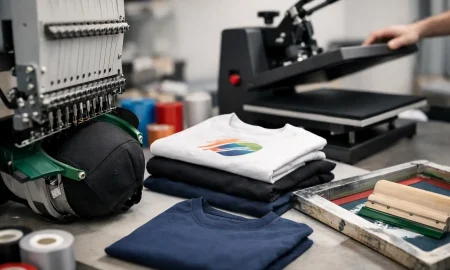
Personalised textile remains one of the best investments when you need to combine visibility and team identification. A well-printed t-shirt or polo makes it instantly easy to spot the right people on a stand, at a reception desk or along a route. It is also a mobile medium, visible from different angles, that keeps working as long as your team is on the move. You simply need to choose the cut, colour and printing technique according to use, because a garment worn for eight hours at a fair has different requirements from a textile handed out as a souvenir.
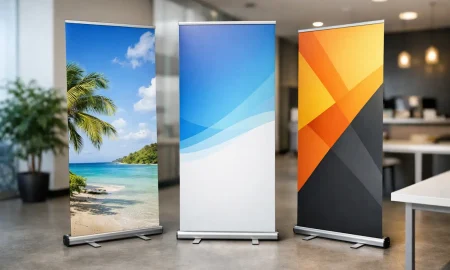
The roll-up banner plays a different role. It displays a clear message, a visual universe and a brand reference from a distance. It is an effective medium if your design gets straight to the point. Too much text, too many secondary logos or information placed too low quickly reduce its effectiveness. For this type of product, the quality of the file and the visual hierarchy matter as much as the printing itself.
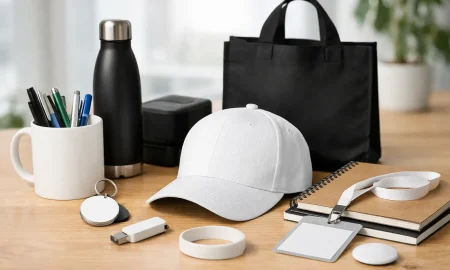
Promotional items follow a more tactical logic. A pen, a notebook, a mug or a water bottle do not have the same lifespan or the same perceived value. The right choice depends on the distribution context. A pen is simple, inexpensive and suited to large volumes. A water bottle or mug can better enhance your image, but the investment only makes sense if the target audience is sufficiently qualified. In other words, not all promotional items suit everyone.
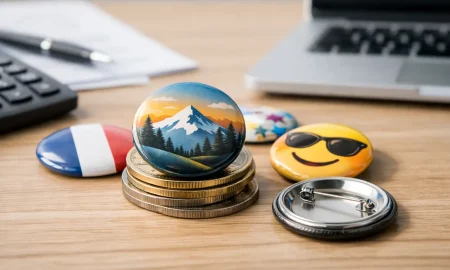
Lightweight materials such as stickers and magnets are often underestimated. Yet they work well for short campaigns, student events, festivals and mass distributions. Their main advantage is simple: they are easy to produce, easy to transport and easy to distribute. However, they do not replace a more substantial presence item if you have a stand to dress.
What to check before ordering
The first criterion is legibility. At events, attention spans are short. A successful visual on screen can become ineffective once printed if it is too dense or poorly contrasted. Check text size, logo placement, colour consistency and visibility from a distance. A cluttered material is not more informative. It is often just less clear.
The second point is compatibility between your visual and the chosen product. Not all decoration reacts the same way depending on the material, the product colour or the fineness of the design. On textile in particular, the result depends greatly on the type of fabric and the printing technique selected. So think about the final result, not just the mock-up.
The third issue is volume. Volume pricing makes certain orders much more attractive once quantities rise. For a company running several events a year, pooling requirements can noticeably lower the unit cost. Conversely, if you need small, targeted runs, prioritise products that keep a strong impact even in low quantities.
Lead time is not a detail
Many event projects are decided late. That is a reality. But the shorter the lead time, the more the product choice, level of personalisation and finishing options may be restricted. Planning ahead not only secures delivery, it also gives you a better balance between budget, quality and quantity.
In-house production offers a concrete advantage here: more control over each stage, greater responsiveness and less uncertainty about tracking. For a buyer, this changes the picture, especially when varied runs must be ordered within a single operation.
Building a coherent pack rather than a scattered order
The best event orders are not necessarily the largest. They are often the most coherent. A simple pack with team textile, roll-up banner, tote bags and pens may be enough to cover visibility, welcome and recall. If you then add products without a clear purpose, you increase the budget without gaining effectiveness.
The ideal is to think in three levels. First, what is seen from afar. Next, what helps start conversations on site. Finally, what the visitor keeps after the meeting. This logic helps avoid oversights while keeping an order clear and usable.
For organisations managing several dates a year, it can be useful to distinguish reusable materials from consumables. A roll-up banner or certain textiles can serve across several events. Stickers, till flyers, promotional items and distribution elements will need restocking more often. This simple sorting helps spread the budget more effectively.
A good material is one that is easy to order
Product quality remains essential, but ease of ordering matters almost as much. When a marketing team, a school, an association or a local authority needs to launch production quickly, they need a clear process, readable choices and an understandable price estimate. A well-designed personalisation tool avoids unnecessary back-and-forth and makes validation faster.
This is especially true for mixed orders involving several references, sizes or quantities. When the process is complex, the project slows down even before it reaches production. Conversely, an order that is simple to set up helps secure the schedule, the visuals and the budget much earlier.
At Geekmonkey, this logic is central: offering personalised supports that are easy to configure, made in-house, with clear volume discounts and a response suited to both one-off operations and recurring needs.
What makes the difference on the day
On the day of the event, details become visible very quickly. A uniform textile creates an immediate impression of organisation. A well-placed vertical display helps attract the right visitors. A useful promotional item extends the conversation beyond the stand. Nothing spectacular, but a genuine cumulative effect.
Conversely, an unsuitable support has immediate consequences. A generic item, an illegible visual, a poorly calibrated quantity, or a product with no connection to actual use: these are common mistakes, not technical disasters. They mainly cost commercial effectiveness.
Choosing your event supports is therefore less about piling up references than about preparing a simple, visible and useful set-up. When each support has a clear function, the order becomes easier, the budget more logical and your presence on site considerably more effective. And it is often this clarity that makes the difference between an event endured and one that is truly profitable.
Share this post
Author





Leave a Reply