


Personalised event sweatshirt: how to choose well
At a trade show, a festival, an open day or a field operation, a personalised event sweatshirt often does more than a simple t-shirt. It dresses the team, makes people identifiable in seconds and looks more premium when the weather is cool or changeable. For many organisers, it is also an item that lasts beyond the event, which completely changes the cost-to-visibility ratio.
Still, the right choice does not depend only on the logo to be printed. Cut, fabric weight, print area, legibility at a distance, order quantity and production lead time all have a direct impact on the final result. If the aim is to equip a team or sell textiles on site, think about practical use before thinking about visuals.
Why choose a personalised event sweatshirt
A sweatshirt is first and foremost a practical garment. It suits indoor and outdoor events, is comfortable to wear all day and gives a stronger visual presence than a more discreet accessory. For a reception team, volunteers, a technical crew or brand ambassadors, it lets you identify the right contacts without having to explain who is who.
It also has a simple but decisive advantage: it is rarely seen as a disposable item. A good sweatshirt continues to be worn after the event, in a professional, associative or personal setting. This extends the visibility of the message, provided the design does not look like a dated or overly promotional uniform.
For an organisation managing its budget, this is an important point. The unit cost of a sweatshirt is higher than a t-shirt, but its potential for use is also longer. If you are looking for a garment that delivers both on-site identification and reuse afterwards, the sweatshirt is often the right compromise.
When a sweatshirt is more relevant than a t-shirt
It all depends on the context. For a summer race or a very mass-market event in strong heat, the t-shirt remains more suitable. However, as soon as there are waiting periods, set-up and take-down, early morning travel, outdoor activity or a transitional season, the sweatshirt becomes more logical.
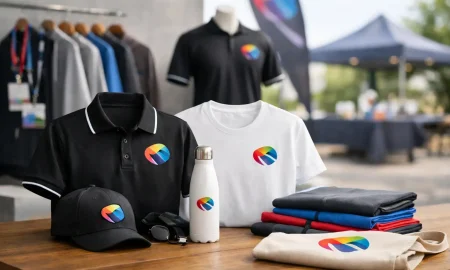
It is also the right choice when brand image matters a great deal. A well-printed sweatshirt gives a more structured, more premium and more coherent look for a stand, a sales team or a corporate operation. For a school, an association or a local authority, it works very well for creating a sense of belonging without becoming overly rigid.
If the garment is to be resold or given to participants, the sweatshirt has another advantage: it has real perceived value. People keep it more easily, especially if the print is clean and the design is wearable day to day.
How to choose the right personalised sweatshirt for an event
The first criterion is use. A sweatshirt for staff does not have the same requirements as a merchandising sweatshirt. For an events team, legibility, speed of identification and a cut that is easy to distribute are usually the priorities. For resale, more attention goes to style, comfort and a more discreet branding.
Fabric weight also matters. A lightweight model may lack structure and look less high quality. A very thick one may be less versatile and warmer than necessary. In most cases, a mid-weight sweatshirt offers the best balance between comfort, structure and ease of printing.
The cut affects how well it is adopted. Unisex, hooded or crew neck, kangaroo pocket or not: there is no universal answer. The crew neck is often simpler for kitting out a team, as it suits more body types and leaves a large print area visible. The hooded sweatshirt has a more casual image and works very well for associations, schools, youth events or merchandising.
You also need to anticipate sizes. At an event, distribution errors cost time. When you are kitting out an entire team, it is better to collect sizes in advance rather than working from estimates. This seems basic, but it is often where smooth running on the day is won or lost.
The visual: what really works on a personalised event sweatshirt
On textiles, not all visuals are equal. A very detailed logo, small text or subtle effects can lose legibility once printed. An event generally calls for a print that can be read quickly, from a few metres away. So aim for a design that is clear, high-contrast and clean.
Where the print is placed should depend on the goal. A chest print over the heart works well for a understated identity. A large back print is very effective for making a team visible in a crowd. A large chest graphic is better suited to a promotional sweatshirt or an assertive merchandising piece.
The colour of the garment has a strong influence on the result. A white design on a dark sweatshirt can be very striking. Conversely, a multicolour logo on an already busy base can lose impact. The simpler the message, the stronger the result. This is not a question of creativity, it is a question of effectiveness.
Which print method to choose for an event sweatshirt
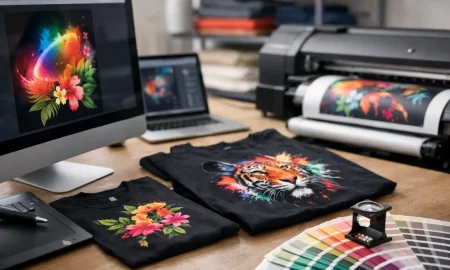
As Geekmonkey specialises in textile printing and does not offer embroidery, the choice comes down to printing techniques suited to the visual, the garment and the quantity. This is an advantage when you want a sharp result, clear personalisation and production designed for events.
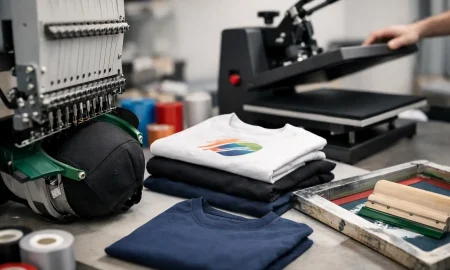
For bold logos, text and visuals, textile printing delivers a precise and legible result. The exact choice depends on the number of colours, the complexity of the file and the order volume. For a small run, some solutions are more flexible. For larger quantities, others become more attractive in terms of unit cost.
Above all, avoid a common reflex: choosing only the cheapest technique without considering the expected result. A team print for a single day does not have the same requirements as a sweatshirt meant to be worn for months. The right trade-off always rests on three factors: use, visual and quantity.
Quantities, budget and lead times: the real decision points
In event purchasing, price is never looked at on its own. It has to be weighed against volume, lead time and the role of the garment. If the sweatshirt is used to identify a team of 15 people, the need is not the same as for an order of 300 pieces intended for a trade show or internal distribution.
Volume-based pricing quickly changes the economics. The higher the volumes, the more the sweatshirt becomes a relevant communication medium. This is especially true for businesses, schools, associations and local authorities that need to outfit several groups or prepare recurring events.
Lead time also deserves real attention. Many textile orders arrive late, with a fixed date that cannot be moved. In this context, controlling production in-house makes a concrete difference. It allows better control over quality, stages and schedule, which is essential when the textile must arrive before an event opens, not after.
The most common mistakes
The first mistake is overloading the design. Too many elements, too much text, too many colours: on a sweatshirt, this does the brand no favours. The second is choosing a cut or colour based solely on a photo, without considering who will actually wear the product.
The third mistake is underestimating the role of the back. For a team of staff, a back print is often more useful than a large front design. The fourth is placing the order too late, assuming that all sizes and colours will still be available at short notice.
Finally, many buyers forget to think about what comes after the event. If the sweatshirt can be worn outside event day, your investment keeps working. If the print shouts "one-off event" too loudly, it will end up in the wardrobe sooner.
What to prepare before ordering
A personalised event sweatshirt project moves forward faster when a few points are already defined: the desired delivery date, the quantity, the sizes, the colour, the print placement and a usable file. This avoids back-and-forth and secures production.
You also need to be clear about the purpose. Is it a team garment, a product to resell, a participant gift or a promotional item to draw attention on site? The answer influences everything else, from the type of sweatshirt to the print format.
If you are torn between several options, the most useful approach is not to multiply ideas but to simplify the brief. A clear objective almost always delivers a better result than a sweatshirt that tries to do everything at once.
A good event sweatshirt does not need to do too much. It should be comfortable, legible, consistent with your image and ready on time. When these four points are aligned, you get a garment that serves not only on event day, but well beyond it.
Share this post
Author






Leave a Reply