
How to create event promotional items
At a trade show, a forum or an open day, the right promotional item isn't just there to please. It helps people stay visible after the event, identifies a team on site and extends a campaign with an item that is genuinely used. That is why the question of how to create event promotional items deserves a proper method, not just a product chosen at random.
A tote bag handed out at the entrance doesn't play the same role as a name badge, a flask given to staff or a t-shirt worn by the team. Before talking about printing, colours or quantities, you therefore need to start from the use. This is where effective orders are won: when the item matches the situation, the audience and the budget.
How to create event promotional items without missing the objective
The first mistake is to look for a trendy product before defining the expected result. Yet an event promotional item can meet many very different needs. It can drive traffic to a stand, thank participants, equip a team, sell merchandise or give a brand visibility over several weeks.
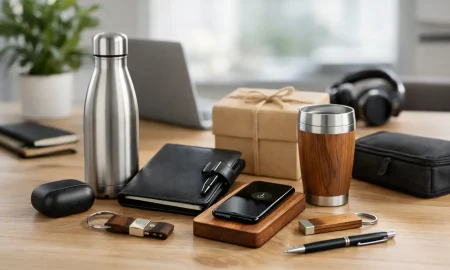
If your goal is wide distribution, favour items that are simple to produce in volume, easy to hand out and have a controlled unit cost. Stickers, magnets, pens or tote bags work well in this logic. If you are looking for an item with a higher perceived value, a mug, a water bottle or a notebook may be more suitable, provided the target audience has a real use for it.
The event itself also matters. For a professional trade show, we often aim for practical, compact items that are easy to carry. For a festival or a community event, immediate visual impact may take priority. For a school, a local authority or a sports race, identifying groups and teams often becomes central, with personalised textiles or accessories that are visible on site.
Choosing the right items for the context
Creating good promotional items isn't about multiplying references. It's about selecting the items that offer the best balance between cost, visibility and usefulness. In many cases, three coherent products are better than a range that is too wide, which complicates the order and dilutes the message.
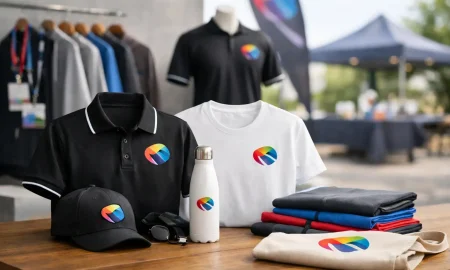
Textiles are particularly effective when you need to make a team identifiable or extend brand visibility after the event. T-shirts, sweatshirts, polo shirts or tote bags offer a large printable area and real potential for use. You do need to be realistic about the context, however: an event t-shirt can work very well if the design is simple and wearable. If it is too promotional, it will rarely be kept.
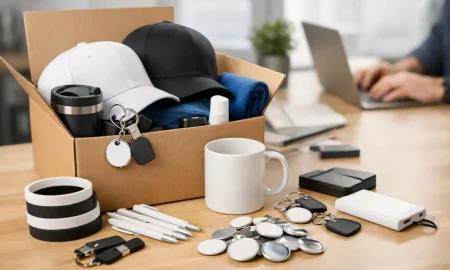
Small promotional items keep a clear advantage for mass distribution campaigns. Pens, magnets, stickers or notebooks are handed out quickly, store easily and help keep a tighter budget. They suit situations where volume is the priority. Their limitation is that they must be graphically legible and useful enough not to be forgotten as soon as people are back at the office.
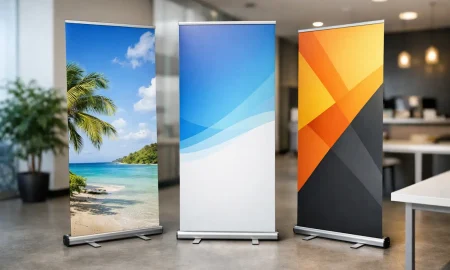
Communication supports such as roll-up banners are not promotional items as such, but they often play a complementary role. They reinforce the visual consistency of the event and make the overall set-up easier to read. In a professional order, it is often worth thinking about the whole: items handed out, textiles worn by the team and signage visible on site.
Visual design matters more than the product
A good item that is poorly personalised remains a poor promotional item. Conversely, a simple item with a clean, legible and well-placed visual can perform very well. The first reflex should therefore be to simplify the message. With an event item, nobody reads a full sales pitch. People remember a name, a logo, a colour, sometimes a date or a short slogan.
The design also needs to be adapted to the item. A detailed logo on a small sticker or a pen won't give the same result as on a tote bag or a sweatshirt. The smaller the printable area, the clearer the marking needs to be. This is especially true for events where items are seen quickly, from a distance or in a visually busy environment.
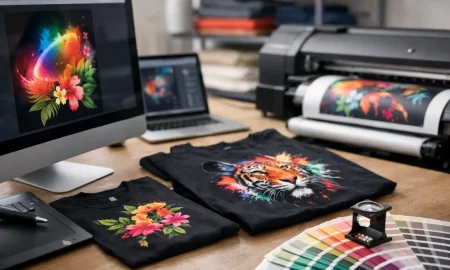
Colours must stay consistent with your identity, but also with the material and colour of the chosen item. A visual that works on screen can lose contrast once printed on dark textile or on a rigid surface. It is better to anticipate this at the design stage rather than correct it too late.
How to create event promotional items on a controlled budget
Budget isn't managed by the unit price alone. It is managed by the useful cost. A cheap item that nobody uses can end up costing more than a slightly more expensive item that the participant actually keeps. The right question is not only how much it costs, but how long the item will keep circulating or being used.
Volumes also play an important role. The higher the quantity, the more interesting volume-based pricing becomes across many references. For a company, association or school that runs several key events during the year, it can be more cost-effective to plan a grouped order rather than rushing small runs at the last minute.
That said, not everything should be ordered in very large quantities. For certain products linked to a specific date, a variable headcount or a restricted target, it is better to stay tight. The most profitable event promotional items are often those planned with precision: enough stock to cover the need, but not so much that unusable leftovers are generated.
Planning production and avoiding unnecessary rush
In events, time pressure is almost always present. Yet rushing often costs more than the personalisation itself. It reduces the choice of products, limits the opportunities for visual approval and increases the risk of errors on sizes, quantities or files.
The best approach is to set a simple timeline. First confirm the need, then the products, then the visuals and finally the final quantities. This logic may seem obvious, but many orders get stuck because production is launched before the list of textile sizes is settled or because the logo supplied can't be used.
In-house production brings a real operational advantage here, as it simplifies follow-up and reduces intermediaries. For a professional client, this matters most when decisions need to be made quickly, a result needs to be confirmed or a quantity needs adjusting. At Geekmonkey, this controlled production approach is precisely what allows us to meet event needs with greater responsiveness and clearer visibility over the expected result.
Choosing the right printing technique
The item isn't everything. The printing technique directly influences the finish, durability and compatibility with your visual. On textiles, for example, it is important to distinguish between uses. A marking for a one-off operation doesn't necessarily have the same requirements as a garment worn regularly by a sales or logistics team.
The choice depends on the product, the material, the number of colours and the level of detail in the visual. It also depends on volume. Some techniques are very relevant for small, varied runs, while others become more interesting as quantities increase. This is not a topic to deal with at the end, because a graphic design that is too complex for the chosen item may force a rethink of the entire project.
You should also stay concrete about the expected result. On a promotional textile, the main criterion may be legibility from a distance. On a mug or a water bottle, you will look for a clean, durable finish instead. The right decision is therefore not the most technical one on paper, but the one that matches the real use of the product.
What makes the difference on the day of the event
The most effective promotional items are not always the most original. They are often the ones that fit naturally into the participant's experience. A useful tote bag handed out on arrival, a well-designed sticker, a t-shirt worn by the team, a notebook given at just the right moment: everything rests on the consistency between the item, the message and the context.
Distribution also needs thought. An item left in a pile on a counter does not have the same impact as one handed over as part of a business exchange, a registration or an activity. The right product, poorly distributed, loses part of its value. Conversely, a simple item can become very effective if it appears at the right moment.
Creating event promotional items is therefore about making useful choices, not piling up references. If the item is suitable, the visual is legible, the volume is well calibrated and production is well planned, the item keeps working for you long after the event has ended. This is often where the order truly becomes profitable.
Share this post
Author




Leave a Reply