


How to choose your event promotional items
A tote bag that gets plenty of attention but is never reused, a pen handed out by the hundred but left forgotten on a table, a well-chosen water bottle that sits on a desk for months – the difference is not down to chance. If you are wondering how to choose event promotional items in a genuinely useful way, you need to start from real usage, not from the most fashionable product of the moment. For a trade show, an open day, a festival, a local campaign or an internal event, the right item is the one that serves your commercial objective whilst staying consistent with your budget, timescales and image.
The most common instinct is to pick an item because it looks appealing in a catalogue. In practice, that is not the right starting point. Effective event promotional items need to answer three simple questions: who is it for, in what context will it be handed out, and what should it achieve after the event? Depending on the answer, you will not head towards the same products or the same printing technique.
How to choose event promotional items according to your objective
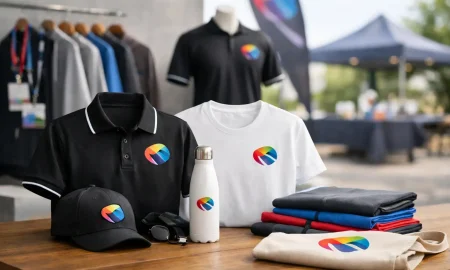
A promotional item does not serve the same function whether it accompanies a stand, a product launch, a recruitment drive, a fundraising campaign or a visitor welcome. If your priority is immediate visibility on site, personalised textiles, bags, badges or wearable items are often the most effective. They create presence in the space and quickly identify a team or a brand.
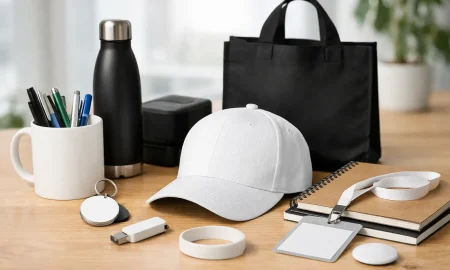
If you are looking for impact after the event, it is better to favour items that last. Mugs, water bottles, notebooks, magnets or pens have a simple advantage: they can become part of everyday life. The right calculation is therefore not just the unit cost, but also how long your logo or message stays on display.
You should also distinguish between the mass promotional item and the item with higher perceived value. For large volumes handed out on a self-service basis, an accessible product that is easy to distribute and cost-effective in quantity is best. For a qualified appointment, an important client or a press kit, you can move up the range. Trying to use a single product for every purpose often leads to an average result.
Audience matters more than fashion
A product that is popular on social media will not necessarily be relevant to your audience. A school, a local authority, an industrial SME, a sports association and a trade show organiser all have different needs. Before approving a product, simply ask whether your recipient is going to keep it, carry it, use it or show it off.
For a young or general audience, stickers, tote bags, t-shirts and water bottles work well when the visual is strong. For a more professional audience, a notebook, a pen, a mug or a understated textile item is often more suitable. For an internal event, there is also a logic of team identification: t-shirts, sweatshirts, polo shirts or bags help unify a group quickly.
The level of personalisation also plays a role. A highly creative visual can work very well on a tote bag or a sticker. On a more institutional item, however, simple and legible branding is often more effective. Overloading a promotional item in an attempt to "get everything across" often reduces its impact.
Budget, quantities and real cost-effectiveness
Price is never judged on the unit cost alone. You need to consider the volume, the distribution method and the expected return. A low-cost item handed out without any filter can represent a high budget if half the copies end up unused. Conversely, a slightly more expensive item that is genuinely kept can be more cost-effective.
This is where quantities change the decision. For large orders, volume pricing often gives access to better products without blowing the budget. It is therefore useful to reason in terms of an overall budget rather than product by product. A tote bag, a t-shirt or a mug can become very competitive as soon as volume increases, provided there is a genuine distribution strategy behind it.
You should also factor in hidden last-minute costs. Ordering too late limits your options, reduces the margin for proof approval and can force you to choose a default item. For a fixed-date event, the right product is also one that you can receive in time, with a consistent finish and suitable branding.
Choosing the right item according to the distribution context
At a trade show, everything happens quickly. Visitors carry, drop, stack and sort. Items that are too bulky or too fragile are rarely the most effective. Tote bags, stickers, badges, pens and notebooks have the advantage of being easy to pick up and simple to carry. If you want your brand to circulate through the aisles, textiles and bags remain safe bets.
For a corporate event or seminar, people often expect something more useful and better finished. A mug, a water bottle, a notebook or a personalised textile item has greater potential here. They can form part of a welcome pack or a participant kit. The benefit is twofold: a better perception of the brand and extended use.
At a local event, a festival or a community action, the durability of the product matters a great deal. Items must withstand transport, weather, handling and sometimes a tight budget. Stickers, magnets, t-shirts and bags are often more relevant than an overly specific item.
Printing, legibility and the final finish
A good product that is poorly printed immediately loses its value. The item must be compatible with your visual, and the reverse is equally true. A highly detailed logo, complex gradients or small text will not give the same result on a textile, a mug or a sticker.
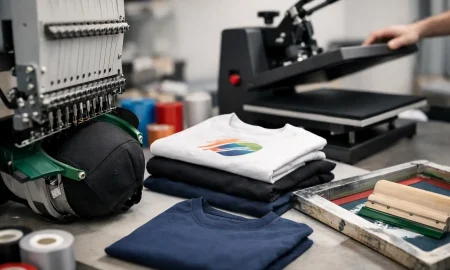
For personalised textiles, the choice of branding directly affects the finish. Motif size, colours, the fineness of the elements and the fabric of the garment must be considered together. It is not enough for a visual to look good on screen. It must remain legible when worn, visible from a distance and consistent with the type of textile chosen. And if you are torn between a t-shirt, a sweatshirt or a polo shirt, ask yourself a simple question: is the item meant to be worn for a day, several times, or in a more professional setting?
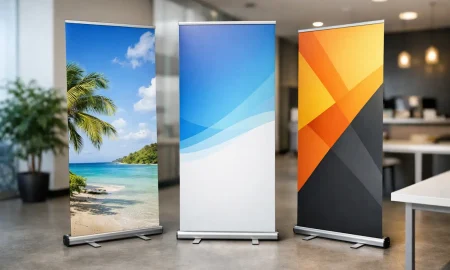
The same logic applies to small items. A pen does not offer the same usable surface as a tote bag. A badge does not carry the same level of detail as a roll-up banner. The smaller the item, the more you should opt for a short message, a clear identity and strong contrast. Trying to print everything everywhere is rarely a good idea.
How to choose event promotional items without getting the timing wrong
Events leave little room for surprises. You should therefore check quantities, files, production lead times and delivery very early. The more personalised your order, the more important it is to approve everything in advance. A visual, size or colour error spotted late will cost you time, sometimes more than money.
The best approach is to work back from the actual date of use, not from the ideal ordering date. Allow a margin for production, transport and receipt. If several products make up your campaign, it is also wise to consider their logistical coherence: a single delivery, simple packaging and quick distribution on site.
A supplier that produces in-house often offers greater visibility over lead times and quality control. This is particularly useful when you need to coordinate textiles, promotional items and communication materials within a single operation. At Geekmonkey, this is precisely what many organisations are looking for: a simple order, appropriate volumes and fast execution without multiplying points of contact.
The right question to ask before approving
Before ordering, set the catalogue aside for a moment and ask yourself this: if your recipient keeps only one item, which one has a real chance of remaining useful after the event? This question rules out many poor choices. It brings you back to the essentials: visibility, use, budget consistency and perceived quality.
A successful event goodie isn't necessarily spectacular. It is simply well chosen, well printed and well distributed. That is often what makes the difference between a communications expense and an item that keeps working for your brand once the event is over.
Share this post
Author







Leave a Reply