

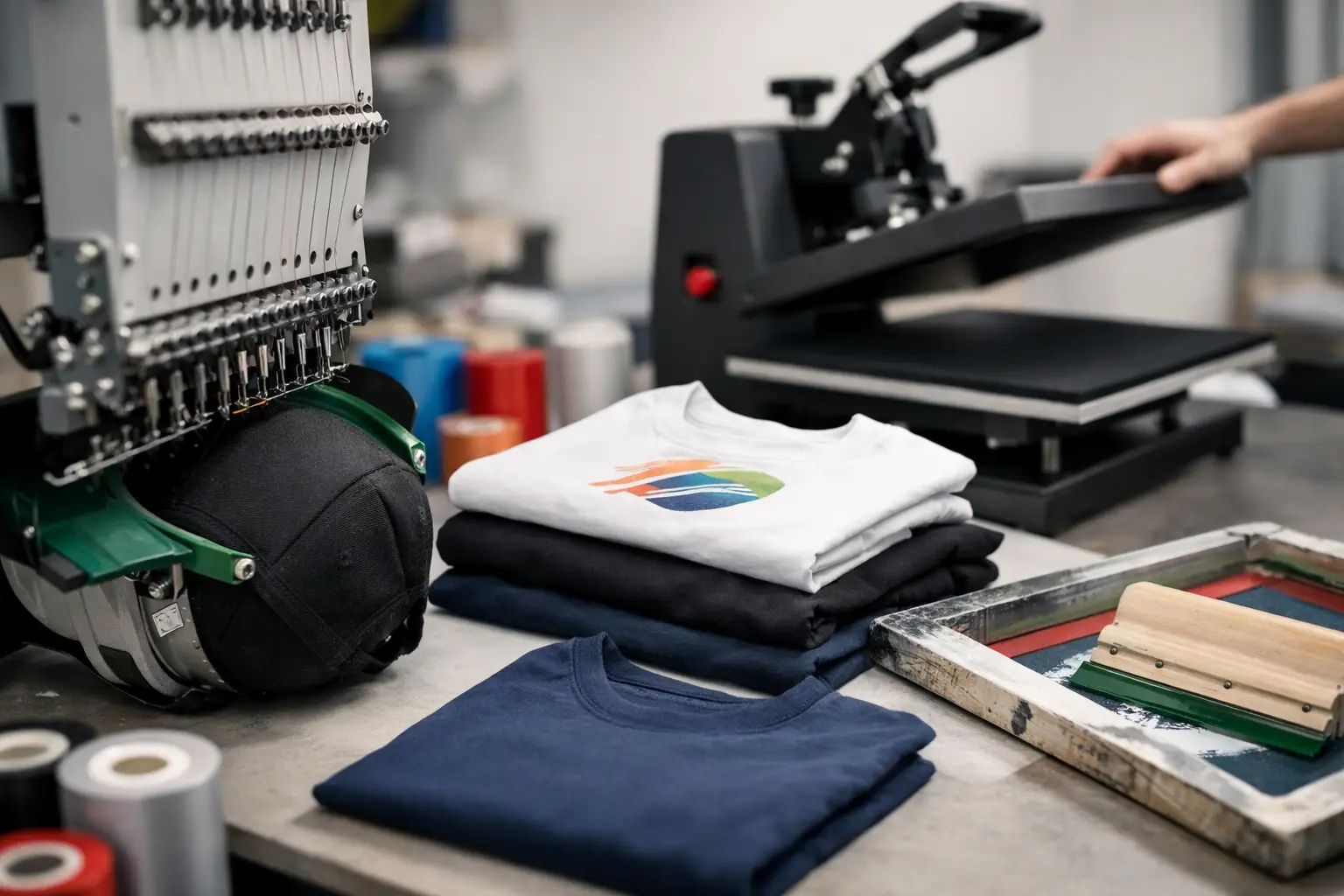
Professional textile decoration guide
Poorly marked textiles are spotted immediately. Dull colours, a visual that cracks after a few washes, a badly placed logo, the wrong fabric – the problem is not only aesthetic, it becomes commercial. If you are looking for a professional textile marking guide, the goal is simple: choose the right printing technique according to use, budget, volumes and the expected result.
For a company, a school, an association or an event organiser, personalised textiles rarely serve merely to "look nice". They must identify a team, make a brand visible, support a field operation or create credible merchandising material. This is why the choice of marking cannot be left to chance.
Professional textile marking guide: what to check before ordering
The first instinct is often to choose the garment and then apply a logo to it. In practice, the right order is rather the reverse: start from the actual use. A staff t-shirt for a festival, a sweatshirt for an internal team, a polo shirt for a trade show or a textile tote bag distributed in bulk do not have the same constraints.
Three criteria make the difference from the start. First, frequency of use. A garment worn for a single day for a one-off operation does not need the same durability as a work textile worn every week. Next, the fabric. Cotton, polyester or blends react differently to printing. Finally, the visual itself. A simple one-colour logo is not handled like a complex design with gradients, fine details or a large printed area.
It is also at this stage that you should think about quantity. Some techniques are very competitive for large volumes, others are more flexible for small runs. The right choice therefore depends less on the "best technique" in general than on the best technique for your specific project.
The main professional textile marking techniques
In the context of textile printing, several processes suit professional needs. All have their advantages, but also their limits. Knowing them helps avoid unpleasant surprises.
Screen printing for volumes and simple visuals
Screen printing remains a benchmark for large orders. It is particularly relevant when the visual is simple, with few colours, and you need to produce in quantity. The result is sharp, the colours are vivid and durability over time is generally very good.
Its main advantage is economic at volume. The higher the quantity, the more attractive the unit cost becomes. On the other hand, technical preparation requires more set-up. For a small run or a visual that varies from one textile to another, it is not always the most flexible solution.
Transfer printing for versatility
Transfer marking is often chosen when flexibility, precision and speed must be combined. It suits logos, name markings, small and medium runs, as well as event needs where lead times matter.
Transfer also allows precise placement on different areas of the garment. This is useful for chest, sleeves or back, with a clean and legible result. Depending on the type of transfer used, very satisfactory results can be achieved on many textiles. The main point of vigilance concerns the match between the fabric, the size of the marking and the intensity of intended use.
Digital printing for detailed visuals
When the visual includes several colours, gradients or fine graphic elements, digital printing is often the most logical route. It allows great visual richness without multiplying preparation costs as a more traditional technique would.
It is a relevant option for more complex designs, small runs or projects that need to preserve the subtlety of a design. On the other hand, everything depends on the quality of the file, the nature of the textile and the compatibility between ink and substrate. An average file rarely gives a good result, even with a good machine.
Choosing well according to the type of garment
Effective marking depends as much on the substrate as on the technique. A lightweight cotton t-shirt does not absorb print like a thicker sweatshirt, and a polo shirt often presents more constraints because of its knit or cut.
On a promotional t-shirt, we usually look for a good balance between budget, legibility and production speed. For a textile intended for a trade show, a street marketing campaign or mass distribution, a reliable, clear and volume-competitive solution is generally preferable.
On a sweatshirt or a more premium garment, the level of requirement rises. The textile costs more, it is worn for longer and it engages the brand image more. In this case, the final result must be clean, durable and consistent with the positioning of the company or event.
Technical garments demand even more attention. Some synthetic fabrics react poorly to certain temperatures or may bleed colour. It is therefore necessary to validate compatibility before production, especially if you work with dark textiles or specific substrates.
The print file: often the real source of problems
Many textile orders are delayed or lose quality because of the file, not the marking itself. A logo retrieved from a low-resolution document, a compressed visual or a poorly prepared background quickly creates visible defects in printing.
For professional use, the file must be clean, legible and suited to the actual size of the marking. Colours must be consistent, outlines sharp and overly fine elements avoided if the textile or technique does not support them well. This point seems basic, but it directly determines the final result.
You also need to think about placement. A logo centred on the chest does not have the same impact as a heart marking or a large back print. The right placement depends on how the garment is used. For event staff, visibility at a distance often takes priority. For team wear or corporate textiles, a more discreet finish may be sought.
Price, quantities, lead times: the real trade-offs
Professional textile marking is not just a matter of finish. You also have to balance cost, volume and timing. An urgent order for an event happening soon is not handled like an annual textile allocation.
If you order in quantity, certain techniques become very cost-effective. If you need several different references, sizes or personalisations, flexibility in execution becomes more important than the unit price alone. This is why volume-based pricing is attractive, but only when it comes with genuine control over production.
In-house production offers a concrete advantage here. It allows better control over lead times, quality of execution and consistency across series. For professionals who need to order quickly and receive on time, this is no minor detail. It is often what makes the difference between a smooth order and one that becomes a source of stress just days before an event.
How to avoid the most common mistakes
The first mistake is choosing the cheapest textile without considering how it will be used. A low price may make sense for a very one-off operation, but not for a garment that will be worn often. The second mistake is underestimating the size of the logo. Too small, and it loses its purpose. Too large, and it can look visually heavy or be less comfortable to wear.
Another common point: wanting to reproduce exactly the same result on every textile. A design may work very well on a white t-shirt and lose legibility on a dark sweatshirt. Colours, size or even the technique sometimes need to be adapted. This is not a negative compromise; it is an intelligent production decision.
Finally, it pays to plan ahead. Urgent orders are possible, but the earlier a project is prepared, the more room you have to choose the garment, the decoration method and the budget. For organisations that order regularly, standardising certain designs or references also saves time on every new operation.
Professional textile decoration guide: the right method for making your decision
The best approach is simple. Start by defining how the textile will be used, then the level of quality expected, then the volume, and only then the decoration technique. This reasoning avoids starting from a theoretical preference that does not match the real-world need.
If you have a recurring need, it is often wise to work with a supplier capable of producing different types of personalised textiles, with a clear understanding of technical constraints and prices by volume. At Geekmonkey, this approach means simple online ordering, in-house production in Belgium and a very direct philosophy: proposing the printing solution best suited to the textile, without complicating the project.
A good textile decoration is not judged only when it leaves production. It is judged when the garment is worn, seen, washed and reused. If your textile remains legible, consistent with your image and cost-effective to order, you have made the right choice.
Share this post
Author








Leave a Reply